The fascinating history and evolution of the violin
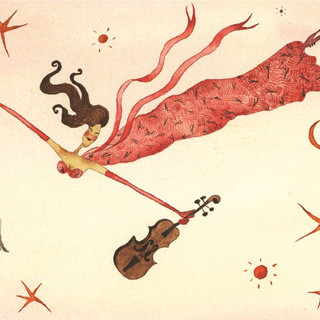

The violin is one of the most important instruments in the world of music. It is renowned for its bright, resonant sound and its vital role in the traditional symphony orchestra, as well as solo performances and chamber ensembles.
It is the highest-pitched instrument of the violin family, which includes the viola, cello and double bass. It is played by using a bow across the strings or by plucking them (called pizzicato) with the fingers.
The big question is, how did this instrument come to be?
Tracing the exact origins of the violin proves difficult. It is said that the violin's ancestry can be traced to earlier bowed instruments, such as the Arabian two-stringed rabab and the three-stringed rebec. These instruments came from the Orient during in the Middle Ages and were commonly played in France and Spain in the fifteenth century.
In the East, the Chinese erhu and the Mongolian morin khuur evolved from the rabab, making them relatives of the violin.

According to National Geographic, most historians agree that today's violin "emerged in the early 16th century in northern Italy." In that region, an area would maintain the violin-making tradition for centuries to come. Brescia, a city located at the foot of the Alps, was one of the first to succeed in violin crafting.
Cremona, a city in northern Italy, became synonymous with the art of violin making. Throughout history, violin makers (both historical and contemporary) in Cremona, known as luthiers, have built some of the world's most famous instruments in music history. They are known for their meticulous attention to detail, adherence to traditional techniques and dedication to preserving the legacy of their predecessors.
In fact, traditional violin craftsmanship in Cremona was inscribed on the Representative List of the Intangible Cultural Heritage of Humanity by UNESCO in 2012.
Among the world's most renowned luthiers who lived in Cremona were Giuseppe Guarneri, Antonio Stradivari and Andrea Amati. Instruments crafted from them remain highly valued today.
At the time, the 16th century violin had an hourglass-shaped body with a curved top and bottom. It also had a long, angled neck. Because of the high quality of the wood used in crafting the violin, with the help of modifications to the soundpost, bridge and strings, the instrument produced a novel and complex sound.
By the 17th century, the violin became popular among composers and musicians alike. In addition, it became an essential component in orchestras and chamber ensembles.
The Baroque era marked a significant time for the development and innovation for the violin. This included tuning the strings to a higher pitch and lengthening the fingerboard, providing the player with more flexibility and a wider range.
This era also saw an emergence of virtuoso violinists, including Antonio Vivaldi, Johann Sebastian Bach and George Frideric Handel. They expanded the boundaries of the instrument and inspired innovative techniques with new approaches to playing. In addition, these composers utilized the violin a lot in their chamber music.
During the Romantic era, lasting from the early 19th to early 20th century, emotional intensity and expression in music were emphasized, especially from the violin. Romantic composers, including Dvorak, Tchaikovsky and Brahms, wrote works that showcased the violin's versatility and sound range.
According to National Geographic, Francois Tourte created the modern bow, therefore standardizing its weight and length. In 1820, the invention of the chin rest and shoulder rest made the violin easier to hold for extended periods of time and augmented its range of play. The neck and fingerboard of the instrument were tilted and lengthened by the 19th century, allowing for much higher notes to be played.
Some of the greatest violinists in modern history include, but not limited to, Janine Jansen, Hilary Hahn, David Oistrakh, Itzhak Perlman, Joshua Bell and Lindsey Stirling. Some of the greatest historical violinists in history include, but not limited to, Niccolo Paganini, Fritz Kreisler, Antonio Vivaldi and Arcangelo Corelli.
The first chair violinist, referred to as the "concertmaster," has become the leader of the orchestra, second only to the conductor. He or she is in charge of tuning the orchestra, as well as coordinating how the other stringed instruments should play their parts to achieve perfect harmony.
Ultimately, the violin's rich history is a testament to its timeless appeal. It continues to evolve while preserving its distinct sound, making the violin both a historical artifact and a living instrument. You can tell someone's life story from their instrument, especially one they have played for so many years.
The violin offers an outlet to express yourself, connect with other people and embrace the joy of music.


Comments